I am excited to share that my graduate student CJ Harris will be presenting their research on binary supermassive black holes (SMBHs) at the 16th International LISA Symposium this summer. The event will be held in College Park, Maryland, from July 6–10.
CJ’s work investigates the evolution and detection prospects of these massive systems, and their attendance is supported by travel funding awarded by the LISA Consortium. This is a great opportunity to engage with the community as the mission continues to take shape.
We look forward to sharing more specifics about the research results closer to the symposium dates!
I recently attended the International Pulsar Timing Array (IPTA) 2025 meeting in Pasadena, CA. It was a highly valuable experience.
A highlight for our group was Cayenne Matt‘s talk, ”Multimessenger Constraints on Evolution of Black Hole Scaling Relations.“ Their modeling indicates that gravitational wave background data requires either a very top-heavy galaxy stellar function or a higher amplitude for the M–Mbulge relation at higher redshift.
My interactions with the IPTA community provided crucial insights. Discussions, including those with Krista Lynne Smith regarding electromagnetic counterparts to continuous wave sources (CWs) and Kris Pardo about his astrometry-based gravitational wave detection research, clarified key challenges. Though CWs are not yet detected, these conversations emphasized the need to strategize now for future discovery, a challenge we are actively addressing.
I’m also keenly anticipating the analysis of the joint IPTA Data Release 3 (DR3).
The meeting offered a vital opportunity to connect, share research, and gain a clear sense of our field’s immediate future. Many thanks to the Scientific Organizing Committee (SOC) and the Local Organizing Committee (LOC) for organizing such a productive meeting!
(A conference picture was taken, but I can’t find it right now. I will post once I find it.)
I was in Bothell, WA right before AAS for a NASA LISA Study Team meeting. We put in some time thinking about the Science Ground Segment and the best ways for NASA to enable astrophysicists to extract science from LISA data. It’s really exciting to think about all the amazing stuff that will come from this. This was my first in-person NLST meeting as I joined the team shortly before COVID.
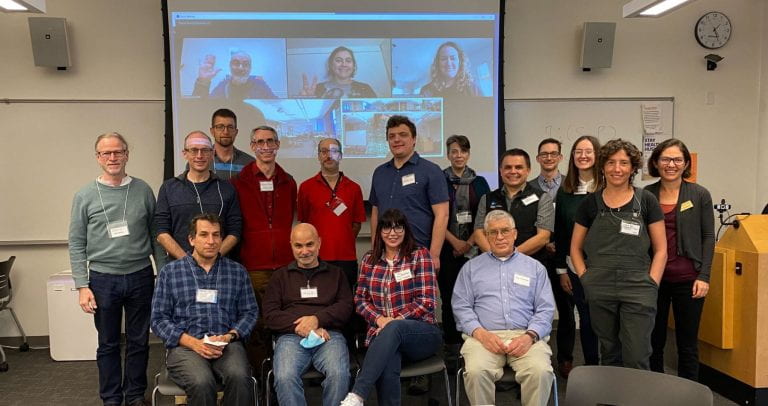
Many thanks to our fearless leader, Kelly Holley-Bockelmann, and our host, Joey Key!