I am pleased to announce that Cayenne Matt’s latest paper—Inferring MBH​Mbulge​ Evolution from the Gravitational-Wave Background—has been officially published in The Astrophysical Journal. This work addresses a major question in modern multi-messenger astronomy: why is the observed gravitational-wave background (GWB) amplitude significantly higher than standard astrophysical models predict?

By comparing semi-analytic models with the observed GWB spectrum, Cayenne’s results suggest that to reproduce the GWB amplitude seen by pulsar timing arrays, one must either assume a significantly higher number density of massive galaxies at high redshift than previously thought, or allow for a positively evolving MBH​Mbulge​ relation. Specifically, the study finds evidence that the MBH​/Mbulge​ ratio may have been higher in the past, evolving as  α(z) = α0​(1+z)1.04±0.5.

A scientific line plot showing the posterior probability density for the parameter alpha-z, which represents the redshift evolution of the black hole-bulge mass relation. Four colored curves (red, blue, gold, and green) represent different model configurations. Most models show a peak in probability at positive values between 0.5 and 1.5, indicating that the ratio of black hole mass to bulge mass was likely higher in the early universe. Horizontal error bars indicate 68 percent confidence regions, and a gray dashed line represents the uniform prior.
This plot displays the posterior distributions for αz​ across the various models tested in the paper. The distributions fall into two categories based on how the Galaxy Stellar Mass Function (GSMF) parameters were handled. Models with fewer degrees of freedom converged to higher values of αz with higher confidence, providing strong evidence for a positive evolution in the MBH​Mbulge​ amplitude.

Full Citation: Matt, C. et al. 2026, ApJ, 997, 188. 
DOI:10.3847/1538-4357/ae2480
NASA ADS:2026ApJ…997..188M

I am very excited to to say that the first NANOGrav paper I am on is out, and it’s a great one! It was led by Caitlin Witt and concerns the search for continuous wave (individually resolved long-lived) gravitational wave sources in the 12.5-year data.

Key figures:
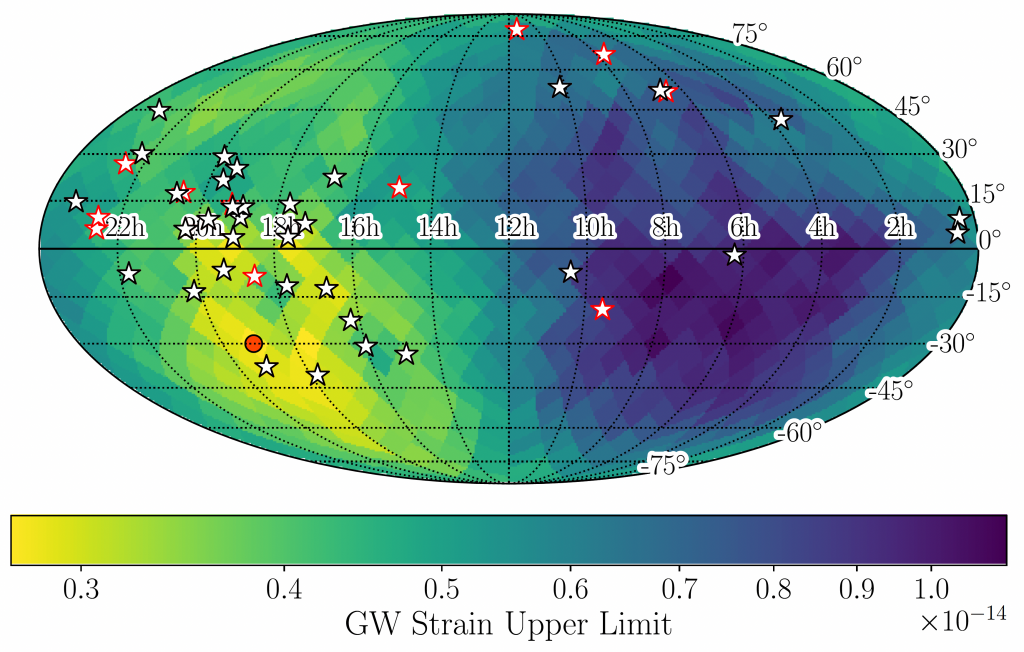
Aitoff projection of the whole sky with colorscale showing upper limit to gravitational wave sources between 0.3e-14 and 1.0e-14. Stars show positions of pulsars clustered to one hemisphere.
Sky map of 12.5-year NANOGrav dataset upper limits to continuous wave sources. Map of CW strain 95% upper limits at f_GW = 7.65 × 10^{−9} Hz, the most sensitive frequency searched, for the 12.5-year data set. Pulsar locations are shown as white stars, with new pulsars added from the 12.5-year data set outlined in red. The most sensitive pixel is marked with a red dot, and is located at an RA of 19h07m30s and a Dec of −30◦00′00′′. In this region, where the our best-timed pulsars lie, our upper limits are nearly an order of magnitude more sensitive than the least sensitive pixel.
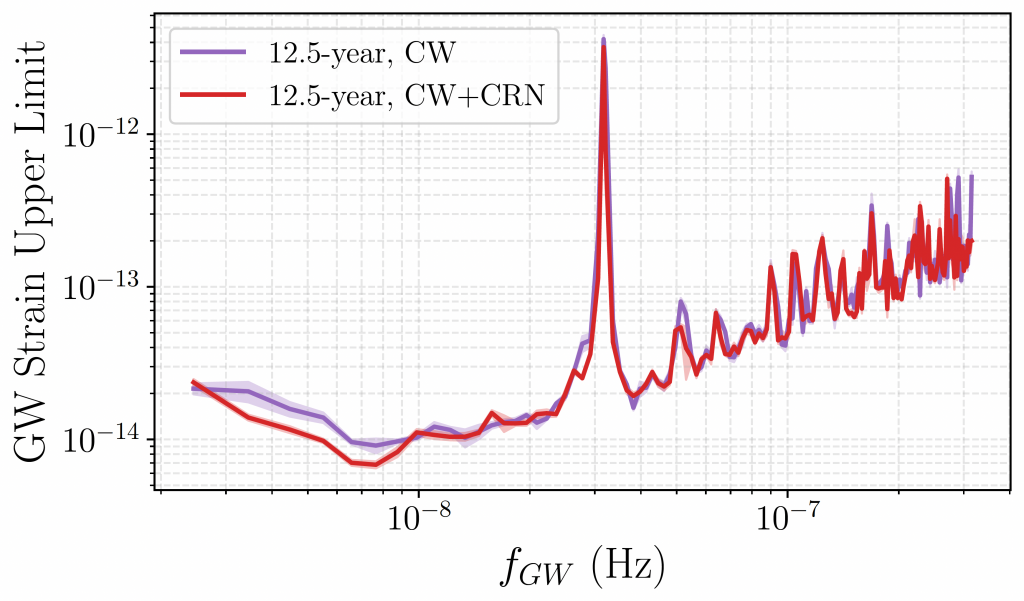
Plot of Gravitational wave strain upper limit as a function of frequency. The limit gets as low as 8e-15 at 7e-9 Hz.
All-sky CW strain 95% upper limits and associated error regions, with (red) and without (purple) a CRN included in the model. At low frequencies, modeling the CRN is necessary to avoid over-estimating our strain upper limits. We are the least sensitive to CWs at fGW =1/(1 year) due to the Earth’s orbit, creating the large feature seen in this and other figures.

Happy to announce that I was just selected as a member of the NLST, which stands for NASA (which stands for National Aeronautics and Space Administration) LISA (which stands for Laser Space Interferometer Antenna) Study Team!

The NLST is charged as proxies for the future LISA user community in the US, to provide scientific analysis to inform these discussions as well as the NASA policy and budget formulation processes surrounding LISA.

I am excited to contribute to this effort as gravitational waves in general and LISA in particular are critical scientific opportunities for fundamental physics and astrophysics in both the US and the world.

I am joining a great team and am even looking forward to adding another telecon to my schedule!

Cover of the LISA proposal document showing a representation of the triangular pattern of the planned LISA spacecraft with Earth in the background and a starry field in the far background. The title reads "LISA: Laser Interferometer Space Antenna". The subtitle is "A proposal in response to the ESA call for L3 mission concepts" At the bottom reads: "Lead Proposer: Prof. Dr. Karsten Danzmann"
LISA L3 Mission proposal cover.