Constraints on Supermassive Black Hole Binary Hardening: CJ Harris Publication and LISA Symposium Talk
I am pleased to announce that CJ Harris’s paper, Core Scouring Dynamics and Gravitational Wave Consequences: Constraints on Supermassive Black Hole Binary Hardening, has been officially published in ApJ. I wrote about this work back in January when it first appeared on arXiv, and it is a pleasure to see it through to print.
The paper takes on the binary hardening problem from a unique angle: rather than treating the shrinking of a supermassive black hole binary as a purely theoretical question, CJ confronts it with two independent sets of observations at once. Using merger trees from the IllustrisTNG simulations, the model builds a synthetic population of core galaxies and predicts the stellar mass deficits that binaries scour out of their centers, comparing them both to the observed relation between mass deficit and galaxy stellar mass and to the nanohertz gravitational wave background measured by pulsar timing arrays.
The result is a genuine tension. Reproducing the observed core population requires stellar scattering to be more efficient than the baseline prescription, a hardening timescale shorter than N-body results predict by a factor of about 1.6. But those same hardening rates, applied to the NANOGrav 15-year dataset, don’t produce the low-frequency attenuation seen in the gravitational wave background. The reverse check fails too: populations generated to match the 15-year data fail to reproduce the mass deficits observed in core galaxies. The two observational ways of looking at it go in different directions.
Something is missing from the stars-only picture, and CJ’s paper lays out the candidates: eccentric binary evolution, gas-driven hardening, gravitational wave recoil, triple black hole interactions, incomplete loss-cone refilling, uncertainties in the black hole–galaxy scaling relation, or galaxy populations that local core galaxies do not represent. My money is on gas. If gas dynamics is doing a substantial share of the hardening, it resolves the tension in a satisfying way. And that potentially makes things very interesting because gas-driven binaries are the ones of glowing brightly for us to see. That would mean better prospects for electromagnetically visible binary AGN than a purely stellar picture would suggest, which is a considerably more optimistic outlook for anyone trying to catch these systems in the act. Settling it will take a population model that handles these effects together, and that is exactly the direction CJ’s working is pointing towards.
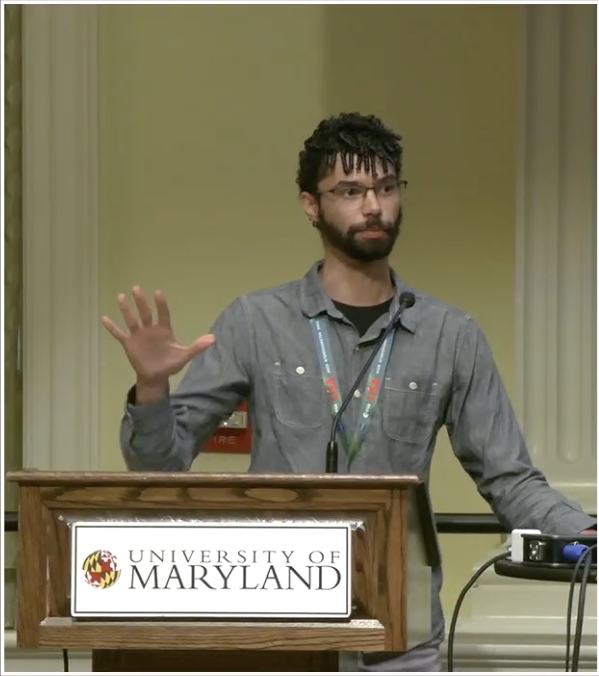
CJ also presented this work at the 16th International LISA Symposium in College Park this past July, supported by travel funding from the LISA Consortium. The session was recorded, and CJ’s talk is available here (the link starts at the beginning of their presentation). It is a compact introduction to the problem and to how the core galaxy population can be used as a constraint on binary evolution, and worth the time if you want to hear it in the expert’s (CJ’s) own words.
The talk also drew out something the paper leaves implicit: how directly this work connects to what LISA will eventually see. The hardening timescales that set whether a binary coalesces, and how quickly, are the same timescales that determine the population LISA will have available to detect. Constraining them now with the galaxies we can already observe is groundwork for interpreting what the mission finds later.
On that front, CJ is developing a method to identify likely hosts of binary supermassive black holes from galaxy properties alone. The idea is to take the observable properties of a nearby core galaxy and turn them into a probability that the galaxy hosts a binary right now, along with a distribution of plausible separations and, importantly, to distinguish gravitationally bound binaries from dual systems. That is a way of pointing observers at the systems most worth a closer look, rather than waiting to stumble across them. More on that when it is ready.
The data underlying this work are deposited in Deep Blue Data, the University of Michigan’s institutional data repository, and will remain publicly accessible for some time.
Congratulations, CJ!